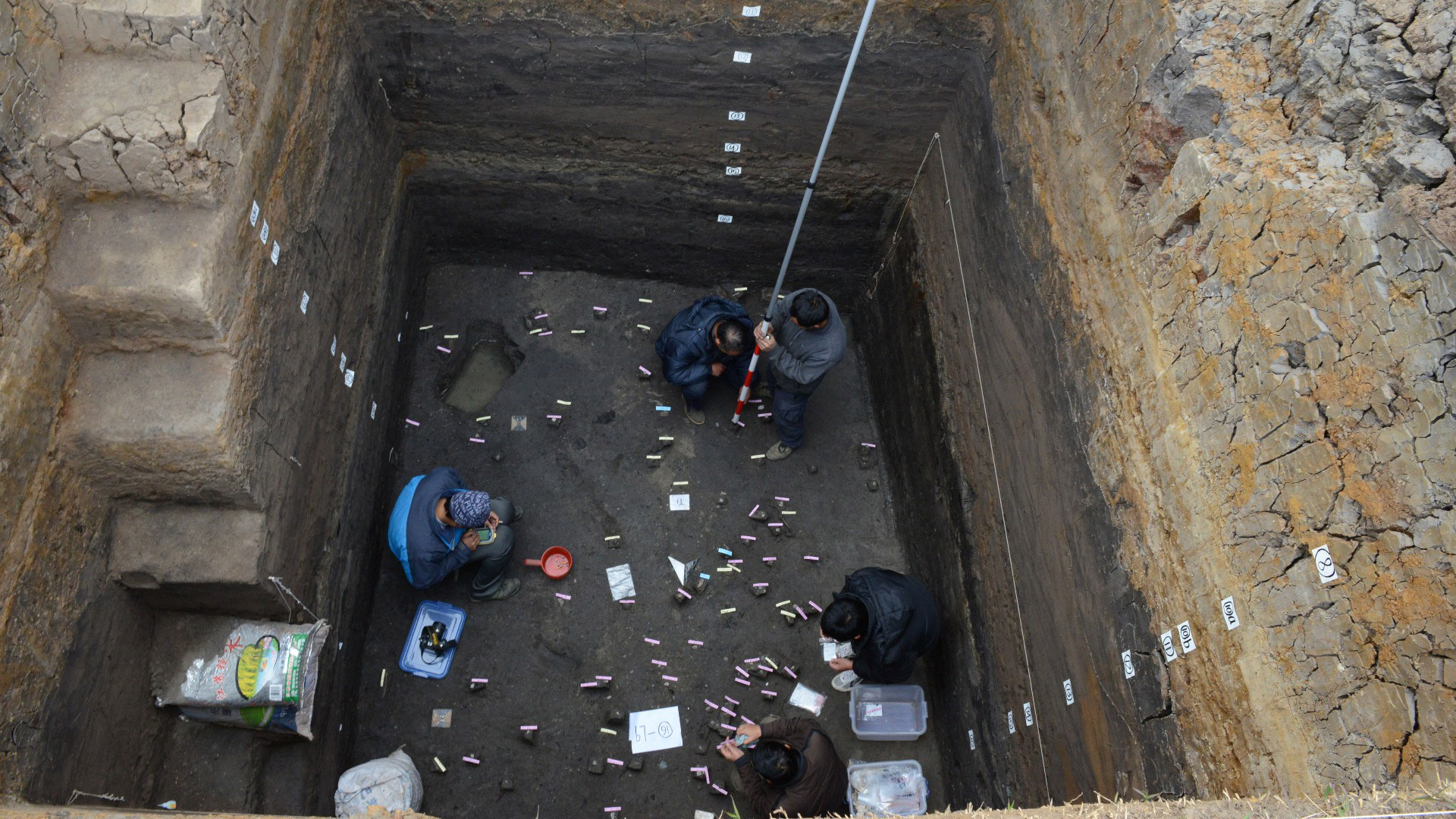
YUNNAN PROVINCE, CHINA—Science News reports that fossils from at least three Denisovan individuals who lived between 167,000 and 134,000 years ago have been discovered in southwestern China's Bianfu Cave by a team of researchers led by Huiyn Rao, Song Xing, and Fan Bai of the Chinese Academy of Sciences; Qijun Ruan of the Yunnan Provincial Institute of Cultural Relics and Archaeology; and Yuhao Zhao of Peking University. The hominin remains, including four teeth, two pieces of a skull, and a fragment of an arm bone, were found near butchered animal remains and more than 1,300 tools. The shape of the human teeth resembles other known Denisovan teeth. Using protein analysis, however, the researchers also determined that they contain collagen specific to Denisovans. The tools recovered from the cave have been dated to between 120,000 and 70,000 years old. No evidence of other human relatives has been found at the site, suggesting that the tools were made by Denisovans, the researchers argue. Read the original scholarly article about this research in Nature. For more on Denisovans, go to "Denisovans at Altitude," one of ARCHAEOLOGY's Top 10 Discoveries of 2019.